Sione Po'uha, a former East High and University of Utah football player who’s now a defensive tackle for the New York Jets, is truly a Utah man. Back in Utah during the NFL lockout, Po'uha, along with seven other NFL players, will host a youth football camp at East High from June 30-July 1 (DreamBigFootball.com), and, on Monday, July 4, throw a free Fourth of July party at Liberty Park (600 E. 1300 South). The Bula One Love Fest kicks off at 8 a.m. with a 5K run/walk, booths, food vendors, free musical performances from The Wailers and others, and finishes with a fireworks show.
What inspired you to hold Bula One Love?
It stems from a company that I started here in Salt Lake City, which produces the Bula beverage, a relaxation drink. It’s also like the hometown kid is coming back—brings his story back, brings his life experience back. I love this place. I’m from here; I was born and raised here. The goal is to formulate it into a traditional [yearly] event. I’m looking at the event like, “Hey, come celebrate, let’s have a great time.” You just gotta do something good. I believe in karma. I believe in good vibes. Anything good, I’m for it.
My dad passed away a couple years ago from pancreatic cancer. I’m a big advocate of the Huntsman Cancer Institute and the things they do, and was even before I found out my dad was affected by cancer. In the morning, we’re having a 5K walk and roll here at Liberty Park and we’d love for people to come out and form groups. We’ve got Moses and Kaylee Kinikini from The Biggest Loser, and they’re going to be the ambassadors of the walk. They’re coming from Idaho and bringing other contestants with them. We’ll have cheer stations, the Utah Rugby team and others. And afterward, we hope people come enjoy the booths and the great lineup that we have, free of charge—The Wailers, they’re ready to go. We made sure that they felt appreciated; they know that the people of Utah are ready to go.
Continue

Showing posts with label Tongan NFL Football Players. Show all posts
Showing posts with label Tongan NFL Football Players. Show all posts
Monday, June 27, 2011


Tuesday, June 21, 2011
Tahi puts on camp as lockout continues
SALT LAKE CITY — Naufahu (Fahu) Tahi, the Minnesota Vikings fullback via BYU and Granger High, is waiting. Waiting for the NFL labor dispute to be settled and the lockout ended; waiting to see how the new labor agreement will affect free agents, since he is one; waiting to see if he should get a high school coaching job to fill the vacated season.
"It's a lot of time off," he says.
Tahi is also waiting for camp to start, but not training camp. He and a group of former BYU players are holding a football camp for kids ages 8 to 18. If you're thinking they are doing this to see them through the lockout financially, you're wrong.
This camp is free.
Several years ago, Tahi teamed with three other BYU graduates — former NFL players Reno Mahe, Gabe Reid and Tavita Ofahengaue — to start a camp for Polynesian kids who couldn't afford to attend any one of the glut of football camps that have become de rigueur for young players. Beginning last year, the camp was opened to everyone.
The camp, which will be held Thursday (2 p.m.) and Friday (10 a.m.) at Alta High, is expected to draw 600 kids. It will include on-field instruction from, among others, Sione Pouha (Jets), Marv Philip (formerly of the Bills), Haloti Ngata (Ravens), Harvey Unga (Bears), Deuce Lutui (Cardinals) and Ray Feinga (Dolphins).
This camp has a new wrinkle: It will include time in the classroom where campers will hear NFL players discuss the value of education. If kids aren't listening to their parents, maybe they'll listen to NFL players.
"There are 119 Division 1-A football programs and only 32 NFL teams with 53-man rosters," says Tahi. "Kids need a Plan B. We're going to let them know that football is the car that drives them to their education. I could not have attended college without it."
Almost everything was stacked against Tahi's bid to make it in the NFL. Not only did he never put up big numbers at BYU, he was pegged for a position that has become all but extinct in the NFL. With the rise of passing offenses and one-back sets, the fullback position was virtually eliminated in the league. Teams rarely even use a draft choice on a fullback — most are late rounders or, as in Tahi's case, undrafted free agents. Tahi signed with the Cincinnati Bengals in 2006 and was assigned to the practice squad.
"They told me later they hadn't planned on keeping me at all," he says "I was a camp body."
Two months later, the Minnesota Vikings not only signed Tahi, but put him on their active roster. During the 2008 offseason, the Vikings also signed Thomas Tapeh, a veteran fullback from the Philadelphia Eagles. "They paid him good money," says Tahi. "I worked hard. I knew I had to." The Vikings wound up releasing Tapeh.
"It was a huge turning point for me," says Tahi.
Ironically, the Bengals offered Tahi a one-year deal worth $1.4 million in 2009, but the Vikings matched it.
He has been the team's starting fullback since then, filling the bruising, unglamorous role of blocking for Adrian Peterson, one of the league's most talented running backs. During the last four seasons, Tahi has just 10 rushing attempts (but he does have 33 catches, two for touchdowns).
In the 2010 NFC championship game against the Saints, Tahi played a role in what is perhaps the most crucial play in recent memory for the Vikings. With the score tied and a minute left, the Vikings were already deep enough in Saints territory that they could attempt a 50-yard field goal. The Vikings called a play that put Tahi on the field, but during a timeout the coaches decided to change to a formation that didn't include the fullback. The coaches forgot to relay the change to Tahi, and the Vikings were penalized five yards for having 12 men on the field; The penalty pushed them out of field goal range. On the next play Brett Favre threw an interception. The Saints went on to win the Super Bowl.
"We felt like we were the best team," says Tahi. "There was just a miscommunication on the sideline."
With the retirement of Favre and a change of coaches, the Vikings are at a crossroads, and Tahi's future with the team is uncertain. He is a free agent and can't be signed by any team until the labor dispute between the players association and the owners is resolved.
"Before the lockout, we met with the Vikings and they said they want me back," says Tahi. "I hope so. I love Minnesota."
He has spent the offseason training in Utah. At 6 feet, he weighs 260 pounds — about 10 more than his target playing weight. Each year he trims the extra pounds shortly before reporting to training camp, whenever that is.
"There will be a season," he says. "I just don't know how long that season will be. It's a waiting game. All I can do is be ready."
Thursday, June 16, 2011
A family affair
By Michael C. Wright
ESPNChicago.com
Archive
ESPNChicago.com
Archive
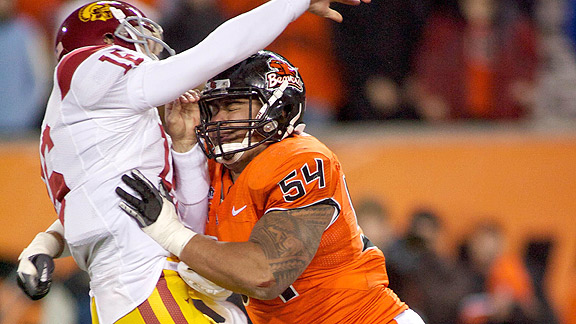 Craig Mitchelldyer/US PresswireStephen Paea said, once off-field issues are settled, he'll be a monster on Sundays.
Having grown up on Vava'u, Tonga, Chicago Bears rookie defensive tackle Stephen Paea heard the word for the first time recently.
"I'm sorry, I don't know the word: juggle," Paea said.
Yet it's exactly what his mother, Ana, did with unshakeable faith, tireless work ethic and navigation of distance in nurturing Stephen and his three brothers (Matahi, twin Will and Pora) throughout their journey to this country for a taste of the American dream. It's also the example Stephen plans to follow by signing his NFL contract and eventually enabling the retirement of Ana and his father Peniamina (everyone calls him Ben), while finally bringing the entire family -- which is scattered between California, Oregon and American Samoa -- together in one place.
Interestingly, most schoolgirls in Tonga are taught to juggle (boys aren't taught). Not just three items in simple patterns, more like four or more intricately tossed about. Explanations for the pastime vary from folklore to a method for time passage on Tonga, comprised of 176 islands in the South Pacific.
Either way, the children's game, called "hiko" by Tongans, has served the family probably more than it realizes.
Stephen chuckles, but acknowledges truth in that assertion after finally hearing the definition of the word juggle.
"Oh [laughing], yes, my mom can do that," Stephen said. "They do that on the islands. It's just something they find to kill the time because, man, if you go to Tonga, it's boring. You can find all the priceless stuff, like the beach, nice places, going somewhere quiet and all that. But being there, living your life there, there's nothing. I don't know how a parent could do all that [juggling] my mother did for her four sons, especially moving from somewhere like that to go to America, the land of opportunity. She's just a hard worker and I love her for that. The only source of income we had came from my mom. She just worked her butt off 24/7, and for some reason, we made it through."
Journey to America
Making it definitely wasn't easy. It's still a struggle every day to navigate the real-life version of "hiko," Ana said.
"It's very true that a lot of things that have happened in my life -- especially trying to handle a lot of things -- is just like the hiko you're talking about," Ana said. "But I still haven't mastered the juggling of my life here in America. I've just taken it one day at a time, and it seems like I was doing the right thing when we first came here. I kept doing it."
“To be able to retire both my parents, get my sister from Tonga to here, and all of these things, it's gonna make me a happy a person. Then I'll be able to perform even better on the field. When the off-field issues are taken care of, I'm a monster on the field.
” -- Stephen Paea
Looking to enhance educational opportunities for their sons, Ben and Ana made the decision in 2003 to bring the boys to America. Ben was initially skeptical, leery of limited job prospects. Ana figured, "If this is in the hands of God, he will find a way for us to move on," and made the trip to America first in November 2003 to prepare for the family's arrival.
Two weeks after arriving, Ana found work as an in-home caretaker for an elderly woman in the Bay Area of California. The job -- which she's held for eight years -- was tailor-made for the family's needs at the time. Because she could live rent free, Ana was able to save virtually every penny of her salary to send for those still waiting in Tonga.
The next summer, the boys touched down in San Francisco International Airport. Stephen and Will were 16. At the time, movies had shaped most of their impressions about life in America.
At least that's how it played out in baggage claim.
"I had my mom's phone number. We didn't have a cell phone, and we tried to look for a pay phone because that's what we saw in the movies," Stephen Paea said. "So what we did was we walked by security guys and cops, looked at them and just said, 'Call mom?' That's all I knew how to say in English. Then, I would point at the phone number. We were just nervous. It was a big city, big airport. Everything was new to us."
Eventually, the boys contacted Ana, and the family took a four-day trip on a Greyhound bus to Lawrence, Kan., where it would settle for a year. Ana spent a month in Kansas using the money she'd saved to set up living arrangements and school enrollment. The boys would live with older brother Matahi (6-foot-4, nearly 400 pounds and nicknamed Big Ben), who was 25 at the time and had already spent time in America living with friends and working. Ana -- still working in California -- would foot the bill for her sons' rent, food and other necessities that first year.
Their father stayed behind in Tonga operating the family business, transporting crates of fish and fresh produce for school lunches in Samoa.
Lawrence High School gave Stephen and Will their first introduction to American football.
"When they were in Kansas and the coach was trying to tell Stephen what to do, he would look at Ben and he would tell Stephen in Tongan what to do," Ana said. "They understood English a little, but it was different without the accent. It was hard to understand for them at first, and Metahi played a big role in interpreting."
Stephen still holds the bench-press record (330 pounds) at Lawrence High but was never fully indoctrinated into American football because the family moved the next year to Provo, Utah.
The distance from California to Kansas had become too much for Ana to bear.
"I just missed them. When I would ask for a week vacation, I would only get to see them for five days because it took two days to travel," Ana said. "That's the reason I wanted them to come from Kansas."
Rugby to football
Brought to Tonga in the early 1900s by sailors and missionaries, rugby is the country's national pastime, with other sports lagging behind significantly in terms of interest.
While his family pondered a move to America from Tonga, Stephen, then 16, eyed a professional rugby career. On weekends, Stephen and Will snuck out of the house to catch rugby matches, dreaming of one day becoming stars in the sport. If the journey to America hadn't panned out, Plan B was to enroll at an all-boys school in New Zealand, where they would concentrate on their studies and rugby.
Had Stephen maintained course with rugby, there was a chance he could've gone professional at 17. The strength he displayed in setting an NFL combine record 49 bench-press reps in February was apparent even back then. So was Stephen's speed and explosiveness, which made him virtually unstoppable.
"Stephen was very good, the biggest guy on our [rugby] team," said Will, six minutes younger than his twin and approximately 80 pounds lighter. "Nobody could tackle him. Nobody wanted to run at him. He pretty much took up wherever he was. The other team never had success where he was. So they would run or pass the ball away from him. When Stephen ran with the ball, he carried people on his back. We won championships our first year, then we came to the States."
Football wasn't as easy.
The addition of football padding made Stephen uncomfortable because it diminished flexibility, "but what got me was the helmet because it minimizes peripheral vision," he said. Admittedly, he "played scared" at first, worried he'd take a shot in the gut or be leveled by a blind side collision because of the peripheral vision loss.
Physically, he possessed the requisite tools -- speed, power, explosiveness -- to succeed in football. But after only a brief introduction to the sport in Lawrence, Stephen couldn't harness them.
Once fully immersed at Timpview High School in Provo, Stephen quickly made strides.
"When I first started playing, I would always run past the quarterback. If I counted how many times I ran by the quarterback, I probably could've gotten at least 25 or 30 sacks," Stephen said, laughing. "I didn't know that right when I beat that O-lineman two yards deep in the backfield, I've got to be sure where the quarterback is going. I would just run straight to where he was standing and all he'd have to do is step forward and I'd miss him by a couple of inches."
Eventually, Stephen earned a juco scholarship to Snow College in Ephraim, Utah. Despite Stephen spending a year at Snow as a backup, Oregon State -- wowed by the defensive tackle's raw talent -- took a chance.
He rewarded the Beavers with 37 starts in 38 career games and racked up 129 tackles, in addition to 14 sacks from the 3-technique defensive tackle position. Chicago selected Stephen with the 53rd overall pick (second round) in April, and despite spending limited time at Halas Hall for draft introductions, the defensive tackle already knows a good portion of the Bears' scheme.
In the two or three hours Stephen spent at the team's facilities, he jotted down the "two fronts and 20 plays or so they were teaching me."
"Just a unique guy for us," said Tim Ruskell, Bears director of player personnel. "His effort level and his passion for the game, it was kind of a no-brainer for us."
A family's dream deferred
Based on the rookie slotting system -- which will likely come to an end after 2011 -- Stephen should receive a contract from the Bears worth approximately $2 million guaranteed, more than enough to fund the family's ultimate dream of bringing everyone to the States at one central location.
Living with younger brother, Pora, and their grandmother, Will just finished up a semester at Foothill College in Los Altos Hills, Calif., and awaits full U.S. citizenship. Ana continues working as a caretaker. Her husband still huffs it back and forth between Tonga and Samoa with Stephen's sister, Ramona, 35, now assisting in the family business as the pair hopes for work visas in the U.S.
Stephen, meanwhile, lives in a three-bedroom house near Oregon State with his wife, Susannah, her family and their eight-month-old daughter, Leimana, who at 35 pounds "is so big she can't crawl yet," he said.
Money comes into the home through a modest endorsement deal with Gatorade. But Stephen hasn't even bought a car. He pinches pennies by training at Oregon State, which also provides free meals from time to time.
[+] Enlarge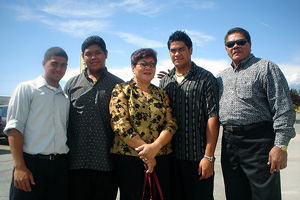
Courtesy of Paea familyThe Paea family from left to right: William, Pora, 'Ilaisaane, Stephen and Peniamina.
Virtually every dime the Paeas earn is redistributed throughout the family. The current NFL lockout only serves as the mechanism for a family's dreams deferred.
"It would be a dream come true [for Stephen to finally sign his contract], because it's like a struggle, you know," said Will, who tore his PCL and MCL playing safety at Foothill College (Stephen plans to pay for surgery with his first check). "Everybody's scattered trying to pitch in just to put bread on the table for everyone."
The perseverance of their parents, especially Ana, only strengthens the family's resolve to see things through.
"We're blessed to have parents like them. No matter how poor we were, they always believed," Will said. "A smile on our faces was like payment for their hard work. They'd rather have that than a million dollars."
Soon, the millions will come, too. Until then, they wait -- and work.
"From my own experience, it doesn't matter what you're doing if you do it right," Ana said. "There are a lot of blessings to be had when you're faithful and honest. I have very strong faith as a Christian, and I've tried to raise my kids according to my beliefs. Family life is not always a smooth ride, but so far, so good. It's hard, but we've handled it. Things are a little bit easier now, and we're looking forward to seeing Stephen play on Sundays. You can pick friends and almost everything else in this world, but God put us -- our family -- together. Every time I see them, it is the best time of my life."
Similar to the tradition of hiko for little girls in Tonga, Stephen juggles his real-life version by training and rehabilitation from a knee injury suffered at the Senior Bowl, in addition to focusing on the life of a husband, father, brother and son. He's promised to retire Ben and Ana and bring everyone together in America to a place the family can call its own.
Sometimes, Stephen reflects on how far he's come, almost simultaneously dreaming of journeys not yet taken.
"I've been thinking about a lot; especially the last couple of months, everything from Tonga to here," Stephen said. "I just envision my family in a nice house. Not just my family here now -- my daughter and my wife -- but my brothers, my siblings and my mom and dad. I just want them in a nice house with nice vehicles living what we call the American dream. To be able to retire both my parents, get my sister from Tonga to here and all of these things, it's gonna make me a happy a person. Then I'll be able to perform even better on the field. When the off-field issues are taken care of, I'm a monster on the field."
It's just a matter of time before the Midway finds out.
Michael C. Wright covers the Bears for ESPNChicago.com and ESPN 1000.
Wednesday, April 20, 2011
Using Strength to His Advantage
Posted Apr 20, 2011
Oregon State's Stephen Paea set a new combine record on the bench press, but he said that strength isn't limited to the weight room.
ENGLEWOOD, Colo. -- At the NFL Scouting Combine, one of the most talked about events is the bench press.
Each position group gathers around what amounts to a stage where one player grinds out as many repetitions of 225 pounds as he can while fellow prospects shout encouragement and dozens of coaches and scouts look on.
So when the defensive linemen entered the room, it was packed. Everyone wanted to see what the biggest men at the combine could do.
North Carolina defensive tackle Marvin Austin went third, setting the tone with 38 repetitions.
From there, 26 prospects came and went, only five of which reached the 30 reps mark. Then came Stephen Paea.
The Oregon State product stands an imposing 6-foot-1, 303 pounds, and set up under the bar ready to impose his will. He did just that, cranking out 43 repetitions without so much as a pause. By the time he was through, he had set a new combine record with 49 repetitions.
"I think I can go back and do another one," he would later say at the podium. "My goal was 50 -- I was a little bit mad at myself."
Paea, who moved to the United States with his family from Tonga when he was 16 years old, hoped that performance helped boost a draft stock that already saw him projected to be picked within the first two days.
At Oregon State, he racked up 129 tackles, 29.5 tackles for loss, 14 sacks and three pass breakups over three seasons. He graduated as the school record holder for forced fumbles with nine.
Continue
Continue
Monday, October 11, 2010
Mormon faith infuses all aspects of life for Vai Sikahema
Last in a three-part story. Parts one and two looked at Vai Sikahema's unlikely rise from poor Tongan immigrant to BYU and NFL football star who has become a media celebrity in Philadelphia. The final installment looks at Sikahema's commitment to his faith and an inspirational journey back to Tonga.
It should have been a thrilling moment. In 1996, just two years after he began his full-time broadcasting career, Vai Sikahema was invited to a meeting and offered a promotion to sports director and sports anchor. This meant he would anchor the sports news at 6 and 11 on weekday nights and cover the Philadelphia Eagles on Sunday. It was a dream job, but Sikahema's elation was tempered by one problem: He had just been called to serve as a bishop in his Mormon ward.How could he reward his bosses' generous offer by telling them he had more compelling duties that would preclude him from meeting all the demands of his new job? How could he explain that he needed to be at church on Sundays, instead of traveling with the Eagles? How could he explain that he needed to be at his church on weeknights, as well, instead of the studio?
Sikahema sought inspiration in the temple of The Church of Jesus Christ of Latter-day Saints and found it.
"I could see in my mind's eye exactly what I was supposed to do and what I was supposed to say to my bosses," he says. He immediately wrote these thoughts on the back of a business card, and two days later, he met again with station manager Pat Wallace and news director Steve Doer.
"There's something you should know," he began. "I don't know if this will make a difference in my promotion, but there might be some conflicts in my personal life."
Continue
Sunday, October 10, 2010
NFL Poly Summary
Cincinnati linebacker Rey Maualuga finished with 8 tackles and 1 sack in a 24-21 loss to Tampa Bay.
Kansas City tight end Tony Moeaki led the team with 4 receptions and 50 yards in a 19-9 loss to Indianapolis.
San Diego receiver Malcolm Floyd had a career high 213 yards on 8 receptions, including a 41 yard touchdown pass in a 35-27 loss to Oakland.
Kansas City tight end Tony Moeaki led the team with 4 receptions and 50 yards in a 19-9 loss to Indianapolis.
San Diego receiver Malcolm Floyd had a career high 213 yards on 8 receptions, including a 41 yard touchdown pass in a 35-27 loss to Oakland.
Saturday, October 09, 2010
The immigrant's song: Vai Sikahema inspires Tongan youths
Second in a three-part series
Thousands of Tongan men and women have migrated to the U.S. since the '60s. At great expense, some leave behind family and friends and the balmy weather of their island home to come to a land of strangers, snow and menial jobs, with no education and no marketable skills or career prospects.
They work as airport baggage handlers, landscapers, furniture movers and concrete finishers.
They make these sacrifices so their children will have more opportunities for education and jobs.
But many of the Tongan youths aren't standing on their parents' shoulders to reach higher. They are passing up educational opportunities and settling for the same menial jobs their parents hold. They are wasting the sacrifices of their parents. It is a recurring theme in Tongan communities. It is a recurring theme in Sikahema's frequent speeches to Tongan groups in Utah.
"Vai is definitely a role model for Polynesians because they see someone who is so successful on and off the football field," says Robert Anae, a BYU assistant football coach and Sikahema's former teammate. "As much as he did in football, he's done more in life."
Sikahema has been a pioneer for his people. First Tongan to win a football scholarship to BYU. First Tongan to play in the National Football League. First Tongan to play in the Pro Bowl.
"I recognize what I've accomplished and what it means to Tongans," he says. "It's frustrating to me that these Tongan kids — the first generation of Tongan Americans — have been afforded every opportunity that American kids are afforded, and they are not taking advantage of it."
Sikahema continues. "I appreciate my life. Every day, I get up thankful. It's impossible to forget the sacrifices my parents made."
The Sikahemas' journey to America was long and difficult. Sione Loni Sikahema and Lupi (Ruby) Potenitila Sikahema left the islands first and settled in Hawaii, leaving their three children with grandparents until they could earn enough money to send for them. They worked in the Polynesian Cultural Center on Oahu for a year before they sent for Vai, the oldest child. Two and a half years later, they sent for the other children.
Continue
Thousands of Tongan men and women have migrated to the U.S. since the '60s. At great expense, some leave behind family and friends and the balmy weather of their island home to come to a land of strangers, snow and menial jobs, with no education and no marketable skills or career prospects.
They work as airport baggage handlers, landscapers, furniture movers and concrete finishers.
They make these sacrifices so their children will have more opportunities for education and jobs.
But many of the Tongan youths aren't standing on their parents' shoulders to reach higher. They are passing up educational opportunities and settling for the same menial jobs their parents hold. They are wasting the sacrifices of their parents. It is a recurring theme in Tongan communities. It is a recurring theme in Sikahema's frequent speeches to Tongan groups in Utah.
"Vai is definitely a role model for Polynesians because they see someone who is so successful on and off the football field," says Robert Anae, a BYU assistant football coach and Sikahema's former teammate. "As much as he did in football, he's done more in life."
Sikahema has been a pioneer for his people. First Tongan to win a football scholarship to BYU. First Tongan to play in the National Football League. First Tongan to play in the Pro Bowl.
"I recognize what I've accomplished and what it means to Tongans," he says. "It's frustrating to me that these Tongan kids — the first generation of Tongan Americans — have been afforded every opportunity that American kids are afforded, and they are not taking advantage of it."
Sikahema continues. "I appreciate my life. Every day, I get up thankful. It's impossible to forget the sacrifices my parents made."
The Sikahemas' journey to America was long and difficult. Sione Loni Sikahema and Lupi (Ruby) Potenitila Sikahema left the islands first and settled in Hawaii, leaving their three children with grandparents until they could earn enough money to send for them. They worked in the Polynesian Cultural Center on Oahu for a year before they sent for Vai, the oldest child. Two and a half years later, they sent for the other children.
Continue
NFL suspends former Miami Dolphins guard Ray Feinga
When the Miami Dolphins waived second-year guard Ray Feinga on Monday, it appeared they were just making room on the roster for rookie linebacker Austin Spitler.
Now, it appears there was more to it than that.
According to an NFL spokesman, Feinga has been suspended four games for violating the league’s policy on performance enhancing substances.
FoxSports.com first reported the suspension but did not list a reason.
Feinga (6-foot-4 and 337 pounds) was signed off the practice squad in the week leading up to the Patriots game to fill the roster exemption the Dolphins received due to the one-game suspension of defensive lineman Tony McDaniel.
“Ray’s really starting to develop nicely,” Dolphins coach Tony Sparano said on Sept. 30. “This guy is athletic and he’s got some strength. I like the things that he’s done.”
However, Feinga, troubled during training camp and the preseason by a concussion and a finger injury, never made it to the game. Now, in the wake of this reported suspension, he won’t be eligible to return to any team’s roster until after Week 8.
Feinga, 24, was undrafted out of Brigham Young in 2009. He spent time with the Rams and Chargers before landing with the Dolphins’ practice squad on Dec. 15 last year.
Friday, October 08, 2010
From Tonga to the NFL: Vai Sikahema beating the odds
Ex-Cougar fights through life to honor grandfather’s legacy
First in a three-part series
Vai Sikahema tried to warn him. An agent representing Jose Canseco, the former Major League Baseball slugger, called to propose a boxing match between Sikahema and Canseco. Sikahema, the BYU graduate and former professional football player who is now a popular TV sportscaster in Philadelphia, thought the fight was a bad idea."You called the wrong guy," Sikahema told the agent. "He's got no chance."
This was the summer of 2008. Sikahema was 45 years old by then and hadn't played football in 15 years or boxed in 31 years. Canseco, famous for home runs, his bodybuilder physique and his admitted use of steroids, was a year younger and much bigger and still trying to hang onto his baseball career in the bush leagues. Divorces and legal issues had beset him with financial difficulties, which is why he turned to boxing.
"You don't want to do this," Sikahema continued. "Canseco is going to be in trouble."
The agent was surprised. How big are you, he asked?
"5-8. 200."
"Well, Canseco is 6-4, 250."
"I'm telling you he's in trouble. Does he know what a Tongan is?"
"No."
"Well, he'll find out. I come from a warrior culture and we fight till one of us is lying on the ground. I grew up boxing."
"Canseco has five black belts."
"OK, we'll see."
Continue
Wednesday, October 06, 2010
Ravens DT Ngata takes humble route to greatness
 | |
| Pittsburgh Steelers quarterback Charlie Batch (16) tries to ward off Baltimore Ravens defensive tackle Haloti Ngata, front right, as defensive end Paul Kruger (99) pursues before a sack in the first quarter of an NFL football game, Sunday, Oct. 3, 2010, in Pittsburgh. (AP Photo/Keith Srakocic) |
OWINGS MILLS, Md. -- No one would blame Haloti Ngata if he talked trash on Sundays and bragged about his accomplishments for the rest of the week.
The Baltimore Ravens' 6-foot-4, 350-pound defensive tackle is equally adept at stopping the run and stalking quarterbacks. He can also drop back into coverage and occasionally plays fullback on offense.
Yet boasting is not Ngata's style.
"He has a gift of his humility," Ravens linebacker Ray Lewis said. "His talent speaks for itself. People just love playing with him because of the type of person he is."
Ngata credits his success to hard work and attributes his unassuming demeanor to his parents.
"My dad had three jobs and my mom just focused on us kids," Ngata said. "My dad pushed it on us to always be humble, never to put anyone above you or below you. I've always kind of been like that. It's been great for me. That's helped me out throughout my life."
Drafted with the 12th overall pick by the Ravens in 2006, Ngata started all 16 games as a rookie and has improved each season. He made the Pro Bowl for the first time last year.
He currently ranks second on the team behind Lewis in tackles and has two of Baltimore's seven sacks.
"He's a force to handle," said Denver quarterback Kyle Orton, who will face the Ravens on Sunday.
"Ngata is playing as good as any defensive lineman in football. There's no question about it," Broncos coach Josh McDaniels said. "We certainly have to be mindful of how we're trying to handle him, how we're trying to block him, not only in the running game but in pass protection because he's shown to be disruptive in both phases."
Ngata's assets are strength, quickness and savvy. If he can't knock down an offensive lineman or squeeze past him, then Ngata will figure out another way to make a tackle.
"You don't find guys that size that can move like he can move," Ravens defensive coordinator Greg Mattison said.
Mattison said Ngata has great pride and is tremendously intelligent.
"What he allows us to do is move him around and play different positions without changing everything. He gets it," Mattison said.
For the most part, Ngata's job is to push aside offensive linemen so that Lewis will be free to make the tackle from his middle linebacker position. Lately, however, Ngata has been removing linemen from the play and making some of those tackles himself.
It's not selfish, but rather a necessity.
"I kind of figured out that linemen were getting off me faster to get to Ray," Ngata said. "I figured if they got off me faster, then I've got to make the play. If I can hold up those guys for Ray, that's great because he'll make a play every time. But if he's got a body on him, it's tough."
Before excelling in football at Oregon, Ngata led his high school rugby team in Utah to rugby national championship in three of his four years. He says some of the skills that he used then - conditioning, open-field tackling and the ability to find an open hole - are still useful today.
Left unsaid is how opponents dealt with trying to tackle a behemoth in a sport without pads.
"If I was a rugby player and I saw him coming at me, I wouldn't want any part of that," Mattison said.
All the punishment that Ngata inflicts on Sundays is taken on a daily basis by his teammates on the offensive line. Even in practice, Ngata is a handful.
"Obviously he's big and strong, but a lot of guys are big and strong. He's explosive," center Matt Birk said. "I think he understands the defense, understands his role, understands where he's supposed to be. This is my second year with him. I knew he was good coming in, but he gets more and more impressive every time I see him."
Ravens coach John Harbaugh credits Ngata as the driving force behind the NFL's second-ranked defense.
"Haloti Ngata is playing as well as any defensive player in the league right now," Harbaugh said. "I'm proud of him. It's not just that; he's a great guy. Nobody works harder, he's a good family man, he's just the kind of guy you root for, he's dominant."
Ngata will make millions of dollars before he retires, so there's really no reason for him to complete the 12 credits he needs to earn his degree from Oregon. But he intends to do the work this offseason.
"I definitely want to do it because it was important for my (late) mom. I want to do it for her," he said. "And my kids, I don't want them to look at me and say, 'Dad didn't get his degree. Why do I have to?' I'd rather them say, 'He's a professional athlete and he also got his degree from college.'"
Saturday, September 25, 2010
Family ties bond Misi and coach who gives him strength Dolphins rookie and assistant strength coach Dave Puloka are third cousins
September 25, 2010|By Mike Berardino, Sun Sentinel
DAVIE — They had no idea of their connection. Not a single clue.
Not before the NFL Draft, when the Miami Dolphins were preparing to take Koa Misi in the second round as Jason Taylor's successor.
Not during rookie minicamp, when the Utah product showed up and began in earnest the process of reshaping his body to outside linebacker standards in a 3-4 NFL defense.
It was only after Misi returned from a celebratory dinner back in Utah with some distant relatives he'd barely even met that Dave Puloka connected the dots.
Puloka, in his third season as the Dolphins' assistant strength and conditioning coach, was working the rookie hard in the weight room during OTA's when Misi casually mentioned they were related.
"My family said they know you," Misi said.
"Oh, really," replied Puloka, also of Tongan extraction. "Who's your family?"
As soon as Misi said the name "Lavulo," Puloka knew. He checked out this unknown branch of the family tree with his cousin Lisa Lavulo, who confirmed it from Los Angeles.
"This is a couple of generations, so the exact connection, we're not entirely sure," Puloka says. "It's a little confusing."
Sione Misi, Koa's father, says they are basically third cousins.
As best they can establish, the connection dates back to Melenaite Misi, Koa's 67-year-old paternal grandmother, and Latu Puloka, the coach's late grandfather.
The Lavulo branch traces back to Ha'apai, one of the smaller islands in the South Pacific chain of 148 tiny land masses – "depending on high tide/low tide," Puloka says —that make up Tonga.
If there are 100,000 residents of Tonga as a whole, there might be no more than 5,000 on Ha'apai. And now two men with roots on that island are working for the same NFL team.
What are the odds?
"It's been weird to find that out," says Misi, who grew up in Santa Rosa, Calif., while Puloka, 31, spent part of his childhood on the island.
Not that it buys Misi any quarter when it comes to conditioning.
"I don't give him any special treatment or anything," Puloka says. "If anything I might be harder on him."
Their connection does lead to some zingers in between squats.
"I joke with him a little bit," says Puloka, who has worked under head strength coach Evan Marcus the past six years. "I'll say, 'If you slack off, I might call up your grandmother and tell on you.' "
Keeping weight on has been the issue for Misi, who was drafted at 244 pounds and has since packed on about 10 pounds of muscle with Puloka's help.
"He's good," Misi says. "Both the strength coaches will push you to your limits and make sure you're doing the right thing. I talk to Dave about eating right."
Seeing Misi now, Puloka can recognize the same family traits that helped him play defensive end at Holy Cross and attend Bengals training camp as an undrafted free agent in 2001.
"Certainly he's a high-motor guy," Puloka says. "His work ethic is tremendous. I'd like to think that runs in the family."
Misi isn't even the only Tongan on the Dolphins. Offensive guard Ray Feinga, on the practice squad, has Tongan roots as well. Fellow outside linebacker Ikaika Alama-Francis is Hawaiian, and nose tackle Paul Soliai is Samoan.
"We've got a Polynesian contingent here," Puloka says. "I kind of talk up the Tongans a little bit. I told Ray he's got some standards to live up to."
Misi, with a sack and a fumble recovery for a touchdown through his first two games, is certainly meeting those standards.
His third cousin couldn't be more proud. Same for the whole Lavulo wing of the family Misi never knew.
"You have to understand the cultural aspects of it," Puloka says. "Even in Tonga, there's no distinction between brother and cousin. It's one and the same. You take care of everybody."
Especially the rookies.
"You hear about the expression, 'You're raised by the town' or 'It takes a village,' well, it really does,." Puloka says. "It's a huge community. If you're related, whether you're second cousin, third cousin, it really doesn't matter. In that culture you're considered brother, sister, very close sibling."
Ha'apai can hardly wait for Sunday's kickoff.
DAVIE — They had no idea of their connection. Not a single clue.
Not before the NFL Draft, when the Miami Dolphins were preparing to take Koa Misi in the second round as Jason Taylor's successor.
Not during rookie minicamp, when the Utah product showed up and began in earnest the process of reshaping his body to outside linebacker standards in a 3-4 NFL defense.
It was only after Misi returned from a celebratory dinner back in Utah with some distant relatives he'd barely even met that Dave Puloka connected the dots.
Puloka, in his third season as the Dolphins' assistant strength and conditioning coach, was working the rookie hard in the weight room during OTA's when Misi casually mentioned they were related.
"My family said they know you," Misi said.
"Oh, really," replied Puloka, also of Tongan extraction. "Who's your family?"
As soon as Misi said the name "Lavulo," Puloka knew. He checked out this unknown branch of the family tree with his cousin Lisa Lavulo, who confirmed it from Los Angeles.
"This is a couple of generations, so the exact connection, we're not entirely sure," Puloka says. "It's a little confusing."
Sione Misi, Koa's father, says they are basically third cousins.
As best they can establish, the connection dates back to Melenaite Misi, Koa's 67-year-old paternal grandmother, and Latu Puloka, the coach's late grandfather.
The Lavulo branch traces back to Ha'apai, one of the smaller islands in the South Pacific chain of 148 tiny land masses – "depending on high tide/low tide," Puloka says —that make up Tonga.
If there are 100,000 residents of Tonga as a whole, there might be no more than 5,000 on Ha'apai. And now two men with roots on that island are working for the same NFL team.
What are the odds?
"It's been weird to find that out," says Misi, who grew up in Santa Rosa, Calif., while Puloka, 31, spent part of his childhood on the island.
Not that it buys Misi any quarter when it comes to conditioning.
"I don't give him any special treatment or anything," Puloka says. "If anything I might be harder on him."
Their connection does lead to some zingers in between squats.
"I joke with him a little bit," says Puloka, who has worked under head strength coach Evan Marcus the past six years. "I'll say, 'If you slack off, I might call up your grandmother and tell on you.' "
Keeping weight on has been the issue for Misi, who was drafted at 244 pounds and has since packed on about 10 pounds of muscle with Puloka's help.
"He's good," Misi says. "Both the strength coaches will push you to your limits and make sure you're doing the right thing. I talk to Dave about eating right."
Seeing Misi now, Puloka can recognize the same family traits that helped him play defensive end at Holy Cross and attend Bengals training camp as an undrafted free agent in 2001.
"Certainly he's a high-motor guy," Puloka says. "His work ethic is tremendous. I'd like to think that runs in the family."
Misi isn't even the only Tongan on the Dolphins. Offensive guard Ray Feinga, on the practice squad, has Tongan roots as well. Fellow outside linebacker Ikaika Alama-Francis is Hawaiian, and nose tackle Paul Soliai is Samoan.
"We've got a Polynesian contingent here," Puloka says. "I kind of talk up the Tongans a little bit. I told Ray he's got some standards to live up to."
Misi, with a sack and a fumble recovery for a touchdown through his first two games, is certainly meeting those standards.
His third cousin couldn't be more proud. Same for the whole Lavulo wing of the family Misi never knew.
"You have to understand the cultural aspects of it," Puloka says. "Even in Tonga, there's no distinction between brother and cousin. It's one and the same. You take care of everybody."
Especially the rookies.
"You hear about the expression, 'You're raised by the town' or 'It takes a village,' well, it really does,." Puloka says. "It's a huge community. If you're related, whether you're second cousin, third cousin, it really doesn't matter. In that culture you're considered brother, sister, very close sibling."
Ha'apai can hardly wait for Sunday's kickoff.
Friday, September 03, 2010
Tuesday, August 31, 2010
Friday, August 20, 2010
Saints waive former Weber State fullback
METAIRIE, La. — New Orleans Saints second-year fullback Marcus Mailei was waived with an unspecified injury, and free agent fullback Jason McKie was signed.
The Saints signed Mailei, a former Weber State star, from Philadelphia's practice squad in December. He played in two games before a hamstring injury put him on injured reserve. He caught two passes for 7 yards in the Saints' preseason opener last week. McKie, a veteran of eight NFL seasons, signed with the Saints in May and participated in their offseason program, but was released just before training camp began in July.
He spent seven seasons in Chicago, starting in 47 games and playing in another 41. He had 29 carries for 84 yards and three touchdowns, and 68 receptions for 364 yards and three scores
Thursday, August 12, 2010
Bears place former BYU RB Harvey Unga on injured reserve
LAKE FOREST, Ill. — The Chicago Bears have placed rookie running back Harvey Unga on injured reserve, meaning he won't play this season.
Taken in the seventh round of the supplemental draft last month, Unga signed a four-year contract but has been bothered by a hamstring injury.
He is BYU's all-time leading rusher with 3,455 yards on 696 carries. He also caught 102 passes for 1,085 yards over four seasons and had 45 touchdowns — 36 rushing and nine receiving.
Taken in the seventh round of the supplemental draft last month, Unga signed a four-year contract but has been bothered by a hamstring injury.
He is BYU's all-time leading rusher with 3,455 yards on 696 carries. He also caught 102 passes for 1,085 yards over four seasons and had 45 touchdowns — 36 rushing and nine receiving.
Thursday, July 15, 2010
Chicago Bears take BYU's Harvey Unga in supplemental draft
Harvey Unga's first child was born a few weeks ago. He's getting married today. Thanks to the Bears, the former Brigham Young running back now has a means of supporting his young family.
The Bears selected BYU's all-time leading rusher in the seventh round of Thursday's NFL supplemental draft, capping off a tumultuous spring and summer for the BYU standout, who was dismissed from his college team this spring for having sexual relations with someone outside of marriage, which is considered an honor-code violation at the Mormon university.
Unga's fiance, former Wheaton-Warrenville South standout Keilani Moeaki, who played for BYU's basketball team, also voluntarily withdrew from the university. The couple's son was born on July 4. Shortly after learning he had been drafted by the Bears, Unga helped set up the tent where his nuptials will take place today in Provo, Utah. "There's always a rainbow beyond those clouds and that's where I'm heading now," a relieved Unga said.
It was the first time the Bears have acquired a player via the supplemental draft since its inception in 1977.
Unga rushed for more than 1,000 yards in each of his first three years at BYU before being dismissed in April. In all, the 6-3/4, 244-pounder rushed for 3,446 yards on 692 carries and 35 touchdowns during his collegiate career and caught 102 passes for 1,085 yards and nine more touchdowns.
"Today's news should help him cover the catering cost at his wedding," joked Unga's agent, Eric Metz.
The selection of Unga was somewhat surprising given the Bears have depth at running back. Unga will compete for a roster spot with veterans Matt Forte, Chester Taylor, Kahlil Bell, Garrett Wolfe and rookie free agent Brandon Minor, formerly of Michigan.
"To be honest, I was surprised," Unga said of the Bears interest. "They're stacked up with running backs right now. They don't need another back. I'm just going to come in there and bust my butt and make the best of the situation. I told them this is something they won't regret and I'm a man of my word."
Unga has chosen his words carefully when discussing the reason for his dismissal from BYU's team but admitted Thursday that it was for the aforementioned honor code violation.
"It's not rocket science, obviously," he said. "It happened. Obviously, it's nothing to hide. Half of the United States probably knows. I'm just trying to make the best of the situation and press forward. I'm human. I made a mistake. I'm facing the consequences. At the same time, there have been positives to what has happened."
One positive is that the couple will now be able to remain close to Moeaki's family, which still resides in Wheaton. "He'll get a lot more sleep in training camp than he would if he were at home, anyway," Metz said.
The Bears selected BYU's all-time leading rusher in the seventh round of Thursday's NFL supplemental draft, capping off a tumultuous spring and summer for the BYU standout, who was dismissed from his college team this spring for having sexual relations with someone outside of marriage, which is considered an honor-code violation at the Mormon university.
Unga's fiance, former Wheaton-Warrenville South standout Keilani Moeaki, who played for BYU's basketball team, also voluntarily withdrew from the university. The couple's son was born on July 4. Shortly after learning he had been drafted by the Bears, Unga helped set up the tent where his nuptials will take place today in Provo, Utah. "There's always a rainbow beyond those clouds and that's where I'm heading now," a relieved Unga said.
It was the first time the Bears have acquired a player via the supplemental draft since its inception in 1977.
Unga rushed for more than 1,000 yards in each of his first three years at BYU before being dismissed in April. In all, the 6-3/4, 244-pounder rushed for 3,446 yards on 692 carries and 35 touchdowns during his collegiate career and caught 102 passes for 1,085 yards and nine more touchdowns.
"Today's news should help him cover the catering cost at his wedding," joked Unga's agent, Eric Metz.
The selection of Unga was somewhat surprising given the Bears have depth at running back. Unga will compete for a roster spot with veterans Matt Forte, Chester Taylor, Kahlil Bell, Garrett Wolfe and rookie free agent Brandon Minor, formerly of Michigan.
"To be honest, I was surprised," Unga said of the Bears interest. "They're stacked up with running backs right now. They don't need another back. I'm just going to come in there and bust my butt and make the best of the situation. I told them this is something they won't regret and I'm a man of my word."
Unga has chosen his words carefully when discussing the reason for his dismissal from BYU's team but admitted Thursday that it was for the aforementioned honor code violation.
"It's not rocket science, obviously," he said. "It happened. Obviously, it's nothing to hide. Half of the United States probably knows. I'm just trying to make the best of the situation and press forward. I'm human. I made a mistake. I'm facing the consequences. At the same time, there have been positives to what has happened."
One positive is that the couple will now be able to remain close to Moeaki's family, which still resides in Wheaton. "He'll get a lot more sleep in training camp than he would if he were at home, anyway," Metz said.
Thursday, April 29, 2010
Misi memories gush from Viking teammates, coaches
By Bob Padecky The Press Democrat
Published: Thursday, April 29, 2010 at 8:00 p.m.
Last Modified: Thursday, April 29, 2010 at 8:00 p.m.
Published: Thursday, April 29, 2010 at 8:00 p.m.
Last Modified: Thursday, April 29, 2010 at 8:00 p.m.
We are going back now, going back six, seven years, when Koa Misi wasn’t a second-round NFL draft choice, when he was a high school football player. We are going back in time for glimpses of that talent which made Misi the 40th pick in the recent draft, images that will make you wish you were there to see him. Like the pinwheel moment.
About five football players, Misi among them, were in the Montgomery weight room, horsing around. As what happens sometimes when teenage testosterone rubs up against another kid who has a strong case of it, things got a little rough.
“Koa sent four kids flying out of the weight room, one right after another, fast, like a pinwheel was turning, spitting them out,” said Jason Franci, Montgomery’s head coach.
With ease, by the way. Franci didn’t hear any grunting from Misi, only from the teammates who landed.
“With ease”, now that’s the phrase I found to be used most commonly about Misi by his ex-teammates and ex-coaches at Montgomery. “With ease.” It wasn’t just what Misi did that was superior, it was how he did it. He did it with ease.
“After a game,” said Todd Vehmeyer, Montgomery’s defensive coordinator, “I’m standing with my back to the locker room door. And remember, I weigh 260 pounds. I’m not small. Koa comes up behind me, picks me up and gives me a bear hug that knocks the wind out of me. Koa? He’s not even breathing hard. You probably heard of someone being ‘country strong’. Well, Koa is island strong.”
Misi, of Tongan descent, created memories of his strength not by walking around and flexing his biceps. To the contrary, he was, still is, modest by nature. Oh yes, those memories came naturally.
“His dad, Sione, was in the tree business,” said Frank Scalercio, Montgomery’s assistant coach, “and one day I was out with Koa and Sione helping them. The back of the end of the truck got stuck in the mud. Koa and Sione lifted up the back end of the truck so I could slide a piece of wood underneath for traction. I remember thinking to myself, ‘Are you kidding me?’”
The truly gifted athlete — this is true of any sport but especially in football — forms the appearance of being twice as big, twice as fast, twice as strong. His very presence creates that enlarged bubble of awe around him.
It happened on the football fields of Sonoma County. The opposition was aware of Misi. Offenses constantly tracked him when he played defensive end. There would be times when a running back or a receiver or a quarterback would see Misi coming.
“And they would freeze, like a deer in the headlights,” Scalercio said. “It might be only for a second but it would be a mistake. Koa won’t slow down. He would just go through you.”
The results would be predictable because the results would be painful.
“On two consecutive plays against Casa,” said Jeremy Avilla, then a Montgomery safety, “Koa knocked players out of the game. One had a broken arm and missed most of the season.”
Nearly every person I interviewed about Misi remembered at least one game in which a player had to leave after a Misi tackle. He did it not to cripple but just to answer that need he had inside him — to play hard and fast on every play. Misi was developing a legend of awe, borne not only of what he did on the field but what he did off it.
Franci has a wooden platform. It’s three-feet high, two-feet wide. At the beginning of each season Franci asks his players to jump on it. He wants to see athletic ability.
“Each season I have four of five players who can land on the platform,” Franci said. “Koa is the only player I ever coached who jumped OVER it.”
Jumping is an important skill not just for a basketball player. It reveals flexibility, or a lack of it.
“Koa’s dad had this monster truck, with its flatbed maybe four feet off the ground,” Scalercio said. “We had to go somewhere one day and his dad said, ‘Koa, get in the back.’ Because the tailgate was so high, people hoisted themselves up. Koa? He jumped from a standing position and landed in the back. Like it was no big deal. Like he did it all the time. He looked like a gazelle. I mean it. And what I remember most, his landing was soft. I just shook my head. Couldn’t believe it.”
So he was a teenager, 6-foot-2, 225 pounds, island strong, a gazelle-type leaper, lover of contact. What else?
“Koa was so quick,” said Marcus Ezeff, a Montgomery teammate, now trying out with the New York Jets, “he’d catch people without them seeing him, and he’d cream them. He did it to this one kid at Casa and the kid just laid there the longest time. It was the kind of speed you see in college. I was always happy I never was on the opposite line of scrimmage.”
So what did Misi lack? Nothing.
“Koa reminded me a lot of Jerry Robinson,” Franci said of the ex-Cardinal Newman star who played 13 years in the NFL.
“Sure, yeah, we’d like to say the coaches made Koa a great player,” Vehmeyer said. “But that’s not true. Not with Koa. He was there already. And he was a great teammate.”
Misi never big-timed his high school buddies when he went to Utah or when the Dolphins drafted him last week. Fact is, he concealed his talent, his skills. He was, and is, the textbook definition of humble.
“That’s why when Koa was drafted,” Ezeff said, “it felt like I was drafted, too. We all root for Koa.”
Vehmeyer has a special rooting interest in Misi.
“I meet with my kids at the beginning of the year,” Vehmeyer said, “and I tell them, ‘You’re not going to play in the NFL but if by some chance you do, I want season tickets.’ I reminded Koa of that this week and all Koa said, ‘Coach, I don’t remember you saying that.’”
Vehmeyer laughed when he told the story. He doesn’t need the tickets. In fact, he could even say that Misi won’t show him anything in the NFL that he hasn’t seen already. Catch someone from behind like the guy was standing still? Drive through a ball carrier like he’s cotton candy? Run sideline-to-sideline like an obsessed border patrolman?
Yep, Vehmeyer’s been there. Seen that. Applauded. Gawked. Once, Koa Misi was a man among boys. Like Vehmeyer or Franci or Ezeff would say, you should have been there. A 225-pound blur of a hammer isn’t seen in these parts all that often.
For more on North Bay sports, go to Bob Padecky’s blog at padecky.blogs.press
Monday, April 26, 2010
Vuna Tuihalamaka signs with Indianapolis
For players looking for work, the day after the NFL draft can be a stressful game of musical chairs.
Two Arizona Wildcats are sitting pretty after a productive Sunday.
H-back Chris Gronkowski (Dallas Cowboys) and linebacker Vuna Tuihalamaka (Indianapolis Colts) both signed undrafted free agent contracts, and more UA players could be closer to deals.
Tuihalamaka was in especially high demand. His agent, Steve Caric, said the linebacker had "six or seven offers" to choose from.
"He was a little under the radar from NFL teams, being a juco guy who didn't play much his junior year," Caric said. "But the more teams saw him and watched his film, the more they fell in love with him."
The 6-foot-2-inch, 230-pound Tuihalamaka registered 68 tackles as a senior after having just 20 in 2008.
Indianapolis Colts Website Link
Indianapolis Colts Website Link
Free Agent Joe Tonga signed by New Orleans Saints
14 undrafted players and six draft picks will participate in May 7-9 rookie minicamp
New Orleans Saints Executive Vice President/General Manager Mickey Loomis announced Monday the 14 undrafted rookie free agents that have agreed to terms with the team following the conclusion of the NFL Draft. Joining the Saints will be LBs Jason Beauchamp and Harry Coleman, WR Chris Bell, RBs Carlos Brown, Christian Ducré and Chris Ivory, Gs Brandon Carter and Joe Tonga, DEs Junior Galette and Brandon Sharpe, LS Clint Gresham, safety Ryan Hamilton, DT Jay Ross and CB Marcell Young.
The following is an outline of the 14 players who – along with the club’s six draft choices and other tryout players – will be coming to New Orleans to participate in the team’s rookie minicamp, scheduled to take place May 7-9.
Joe Tonga – Guard, Indiana (Pa.) (6-4, 313): Tonga played his senior season at Division II Indiana (Pa.) University and started nine games on the offensive line for the Crimson Hawks. The Taylorsville, Utah native played one season at Florida State in 2008, playing in 11 games after two standout seasons at Mt. San Antonio (Calif.) Community College, where he earned all-conference honors.
Friday, April 23, 2010
Chiefs move quickly to get tight end Moeaki

The Chiefs traded a couple of draft picks for the right to take Iowa tight end Tony Moeaki in the third round of the NFL draft on Friday.
Tony Moeaki was sitting on his couch, surrounded by family, when it happened. It seemed to pass in an instant. The tight end from Iowa saw on the television that a trade had been made. The Chiefs were picking now at No. 93 overall, at the end of the third round.
Then Moeaki’s phone rang. He was going to Kansas City.
“It happened within seconds,” he said Friday night. “Lightning quick.”
Things can happen that quickly during the NFL draft, and a player’s luck can change that fast, too. It has happened to Moeaki before.
Here was a promising tight end, with sure hands and strong shoulders, but his legs and feet kept failing him. He broke his left foot in 2007, missing all but four games. A season later, he made one start and had a sprained ankle to worry about, too. The promising tight end was now known as an injury risk, and who knew if he’d ever reach the potential he brought to Iowa City from Wheaton, Ill., a town west of Chicago.
“Definitely frustrating,” Moeaki said. “But that part is behind me.”
The Chiefs are confident that’s true.
Moeaki started all 10 of his games last season, his fifth at Iowa after being granted a medical redshirt year by the NCAA. He had a career-high 30 catches and four touchdowns. That was the kind of season his talent had made possible, but his legs were keeping him from.
When Kansas City made the call late Friday to trade its fourth-round pick (No. 102 overall) and the last of its three fifth-round selections (No. 144), it was ready to bet that Moeaki’s word was good. The Chiefs seem to be drafting with character in mind this year, and they’ve done their homework.
Chiefs general manager Scott Pioli is researching prospects like a president vets a Supreme Court nominee. Team captains. Players with their communities in mind. Youngsters with high football IQs and almost spotless resumes. Moeaki has all that, with the caveat that his talent hasn’t yet overshadowed the injuries.
Still, the 22-year-old Moeaki said he considers himself fully healthy. He said he’s a “complete tight end,” one who’s made his share of blocks, caught his share of passes. But those are his words.
So maybe Pioli turned to an old friend for some reassurance. Pioli and Iowa coach Kirk Ferentz are longtime friends. Moeaki said Friday night that he got used to seeing Pioli hang around the Hawkeyes’ football offices.
Pioli wouldn’t say what kind of endorsement Ferentz gave Moeaki. He said he doesn’t feel comfortable speaking for others. Then again …
“I’ll say Kirk is very fond of him,” Pioli said.
Pioli said he was watching the draft, too. And as the selections kept passing, Pioli kept thinking Moeaki would be gone by the time the Chiefs’ turn came around again Saturday morning, when the fourth round started.
“He was a player that we were talking about earlier,” Pioli said. “We didn’t know what the sweet spot was going to be to try to pick him up.
I didn’t know if we had enough ammunition to make a trade and move up. … The opportunity came where we felt like giving up that late of a fifth-round pick, to be able to move up into this round and get one of the couple of guys that we would’ve been disappointed if we lost before it was our turn to pick.”
So the Chiefs came and got him.
Moeaki said he was casually watching the end of the third round when it all happened. The TV flashed. The trade happened. The phone rang. It was Pioli.
It was done.
“It all fell together,” he said. “I’m just excited that he got me.”
Subscribe to:
Posts (Atom)